
National News
Missing Australian hiker Jordan Yap found dead in Peru

Jordan Yap, 30, last made contact with friends and family on 14 September ahead of a planned 10-day solo trek along Peru’s Huayhuash mountain range, 400km north-east of Lima.
In a social media post on Saturday, his friends and family said “with a heavy heart we are sorry to tell you Jordan has been found, and he did not survive”.
The Melbourne man was last seen near the beginning of his trek across the Cordillera Huayhuash circuit, which is regarded as a challenging, high-altitude trek through the remote Andes mountains. His friends and family became concerned after he failed to make contact on his estimated return date, failed to check back into the Krusty hostel in Huaraz and missed a scheduled flight from Lima to Cusco. He also misplaced a satellite beacon he was travelling with days before he set off on the 120km hike, raising further concerns.
A spokesperson from the Department of Foreign Affairs and Trade confirmed it was providing consular assistance to the family of an Australian who had died in Peru.

National News
Regional universities struggle to enrol international students amid visa refusals

University leaders warn they’re struggling to fill international student places due to visa uncertainty and heated political debate on immigration, with regional areas hit the hardest amid concern that financial deficits could affect domestic students.
The latest numbers from the Department of Education in October show on average universities are filling just two-thirds of their allocated places, and just five public universities have reached more than 80% capacity, all in capital cities.
Mike Ferguson, pro vice-chancellor of international students at Charles Sturt University, which has campuses across regional New South Wales, said his institution has filled just 40% of its cap this year, but he said the university did support Labor’s decision to crack down on onshore student transfers and visa hopping to improve integrity in the system. Charles Sturt University has also estimated the gap between international student recruitments pre-Covid and now is costing $35m, and the university has announced job cuts and restructuring in response.
Prof Andrew Norton, an expert in higher education, said the declining numbers were affecting all public universities because they cross-subsidise their teaching and research with international student fees. Phil Honeywood, chief executive of the International Education Association of Australia, said diminishing international student numbers in regional areas could also lead to critical skills shortages.
National News
Former Treasurer Frydenberg considering return to politics

Frydenberg said he wasn’t closing the door on the desire to one day be prime minister, and that the Liberal party was facing an existential threat and needed to change.
On Saturday, Frydenberg released excerpts of his upcoming memoir A Grateful Son, published in The Australian, which included details of his election defeat four years ago. The former Kooyong MP, who was a leadership frontrunner, fuelled speculation he may contest a seat in the next election as he outlined his vision for Australia.
Frydenberg proposed several policy changes across energy and AI and a pitch to leverage a portion of state GST revenue based on how many homes were built. But Liberal leader Angus Taylor immediately added that the Coalition would not adopt Mr Frydenberg’s suggestion of raising the GST, while saying he’d welcome the former Liberal treasurer back to the party if he decided to recontest at the next election.
National News
ATO will not budge after snap meeting over credit card ban

The Australian Taxation Office (ATO) will not budge on its decision to stop accepting credit card payments from December 1, after holding a snap crisis meeting with business groups angered by the move.
Australia’s tax chief convened a meeting with business groups this morning to discuss the changes in the wake of widespread backlash. But the ATO has indicated it is not going to reverse the credit card ban, according to a spokesperson from the Australian Chamber of Commerce and Industry (ACCI), which attended the meeting.
Last week the tax office announced it would stop accepting credit card payments at the end of next month. That step came in response to the Reserve Bank of Australia’s reforms to scrap card surcharges from October 1, which the bank said was “in the public interest” and would save customers about $1.6 billion a year. The ATO said it would continue accepting credit cards until November 30 to allow for a transition period, saying it was untenable beyond that point.
Small business owners say they have been expected to absorb the fees of card transactions themselves, and have lost the option of using credit card payments to the ATO as a cash flow method. Some feared the sudden change would mean they needed to source cash quickly to begin paying by debit instead, or they would be forced to go into arrears with the ATO, and that could result in enforcement against their businesses, including possible closure.
The Council of Small Business Organisations Australia (COSBOA) said it raised issues for businesses that used credit cards as a cash flow tool and said the decision “warrants a rethink”. Master Builders CEO Denita Wawn also said the surcharge card ban and other regulatory decisions were made “without consultation” and showed a “lack of practical understanding of the impact of decisions being made by this government”.

Beijing residents dispose of drones ahead of ban on ownership
Trump announces Russia-Ukraine partial ‘energy ceasefire’
Missing Australian hiker Jordan Yap found dead in Peru
Regional universities struggle to enrol international students amid visa refusals
Former Treasurer Frydenberg considering return to politics

Cantonese Mango Sago

如果您出現以下症狀,請接受檢測。

FILIPINO: Kung nakakaranas ka ng mga sumusunod na sintomas, mangyaring subukan.

保护您自己和家人 – 咳嗽和打喷嚏时请捂住

How to wear a face mask 怎麼戴口罩
UAE Fully Suspends Trade and Financial Ties with Iran
Victorian Liberal Candidate Counselled Over Volunteer Internship Program

Trump signs order banning “birth tourism” and further restricting birthright citizenship

SpaceX Rocket Debris Hits the Moon, Renewing Concerns Over Space Junk

Australia Sets New Standards for Men’s Behaviour Programs
-
 Cuisine Explorer6 years ago
Cantonese Mango Sago
-
Uncategorized6 years ago
如果您出現以下症狀,請接受檢測。
-
Tagalog6 years ago
FILIPINO: Kung nakakaranas ka ng mga sumusunod na sintomas, mangyaring subukan.
-
Cantonese - Traditional Chinese6 years ago
保护您自己和家人 – 咳嗽和打喷嚏时请捂住
-
 Uncategorized6 years ago
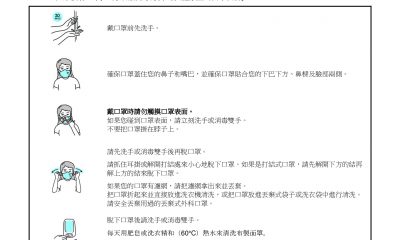
How to wear a face mask 怎麼戴口罩
-
 Uncategorized6 years ago
COVID-19 檢驗快速 安全又簡單
-
Uncategorized6 years ago
在最近的 COVID-19 應對行動中, 維多利亞州並非孤單
-
 Cantonese - Traditional Chinese6 years ago
保護您自己和家人 – 咳嗽和打噴嚏時請捂住
